
TL;DR: A mid fade starts the gradient at the temple (level with the top of your ear) and exposes more skin than a taper while still leaving a soft transition through the upper sides. A high fade starts the gradient near the parietal ridge (the bony curve above your temple), pushing the shortest length almost to the top of your head and creating maximum visible contrast. Pick mid if you want a modern, sharp cut that still flexes into most Sacramento workplaces and rebooks every 2-3 weeks. Pick high if you want a dramatic, photo-ready look, work in a creative or trades industry, and can commit to a chair visit every 10-14 days. The default Sacramento ask at Tay's Barbershop is the mid fade with a half-guard blend — it's the sweet spot between style and longevity.
Mid Fade vs High Fade: The Quick Answer
The difference between a mid fade and a high fade is how far up your head the shortest part of the gradient sits. Heading into summer 2026, this is still the first decision we walk every new fade client through -- and with Sacramento heat pushing more guys toward shorter sides, the question comes up daily.
- Mid fade: the blend begins at your temple — roughly even with the top of your ear — and works upward. The longest length on top still wraps a wide section of your head. From the front, the contrast is visible but balanced.
- High fade: the blend begins near the parietal ridge (where the side of your skull curves into the top), much higher than the temple. The longer hair on top sits on a smaller, more isolated section. From the front, the contrast is dramatic and immediate.
That single decision — where the gradient starts — changes how often you rebook, what your hair looks like at week three, what workplaces it lands in, and what face shapes it flatters. We cut hundreds of both variants every week across our Sacramento, Rancho Cordova, and Howe Ave shops, and choosing the wrong variant is one of the most common things first-time clients regret.
If you're still figuring out whether you want a taper or a fade in the first place, start with our taper vs fade explainer and come back here to dial in the height of the fade itself.
Side-by-Side Comparison
Here's how the two variants stack up on the factors that actually matter once you're sitting in the chair:
| Feature | Mid Fade | High Fade |
|---|---|---|
| Where the fade starts | At the temple, level with the top of the ear | At the parietal ridge, well above the temple |
| Visible contrast from the front | Clearly visible, balanced | Dramatic, immediate |
| Best for workplaces | Most workplaces; pushback rare in Sacramento | Creative, trades, fitness, hospitality |
| Maintenance window | 2-3 weeks | 10-14 days |
| Typical Sacramento price | $40-$55 | $45-$60 |
| Hair needed on top | Any length, more length amplifies contrast | Medium to long top works best |
| Best face shapes | Oval, oblong, square, round | Oval, square, diamond |
| Grow-out behavior | Loses sharpness by week 4 | Looks shaggy by week 3 |
| Photo presence | Sharp, deliberate | Bold, attention-grabbing |
| Annual cut count | ~17-20 | ~26-30 |
The price gap between the two variants is usually $5-$10 at most Sacramento shops. The real cost difference lives in the rebook schedule, which we'll get into below.
What a Mid Fade Actually Looks Like
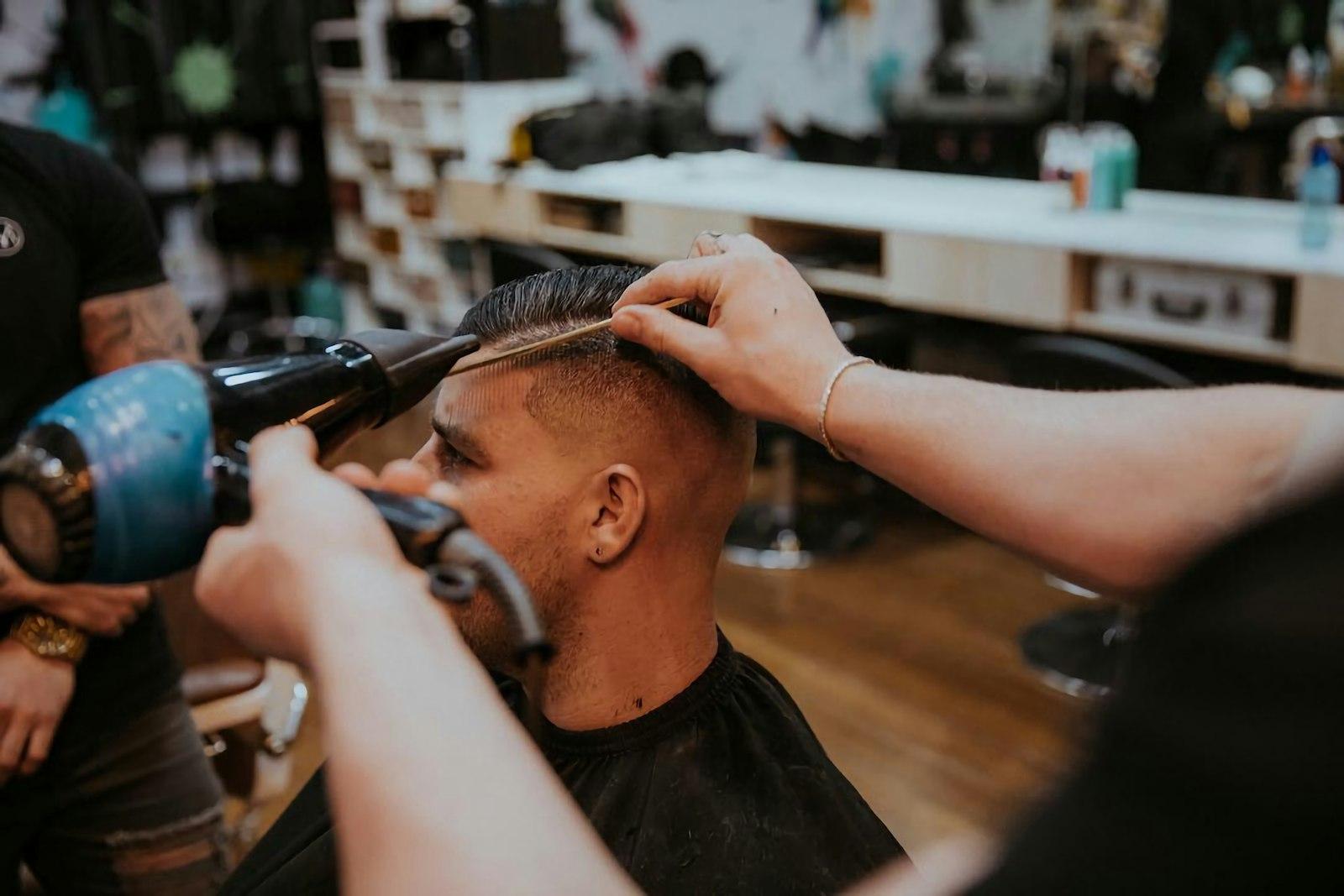
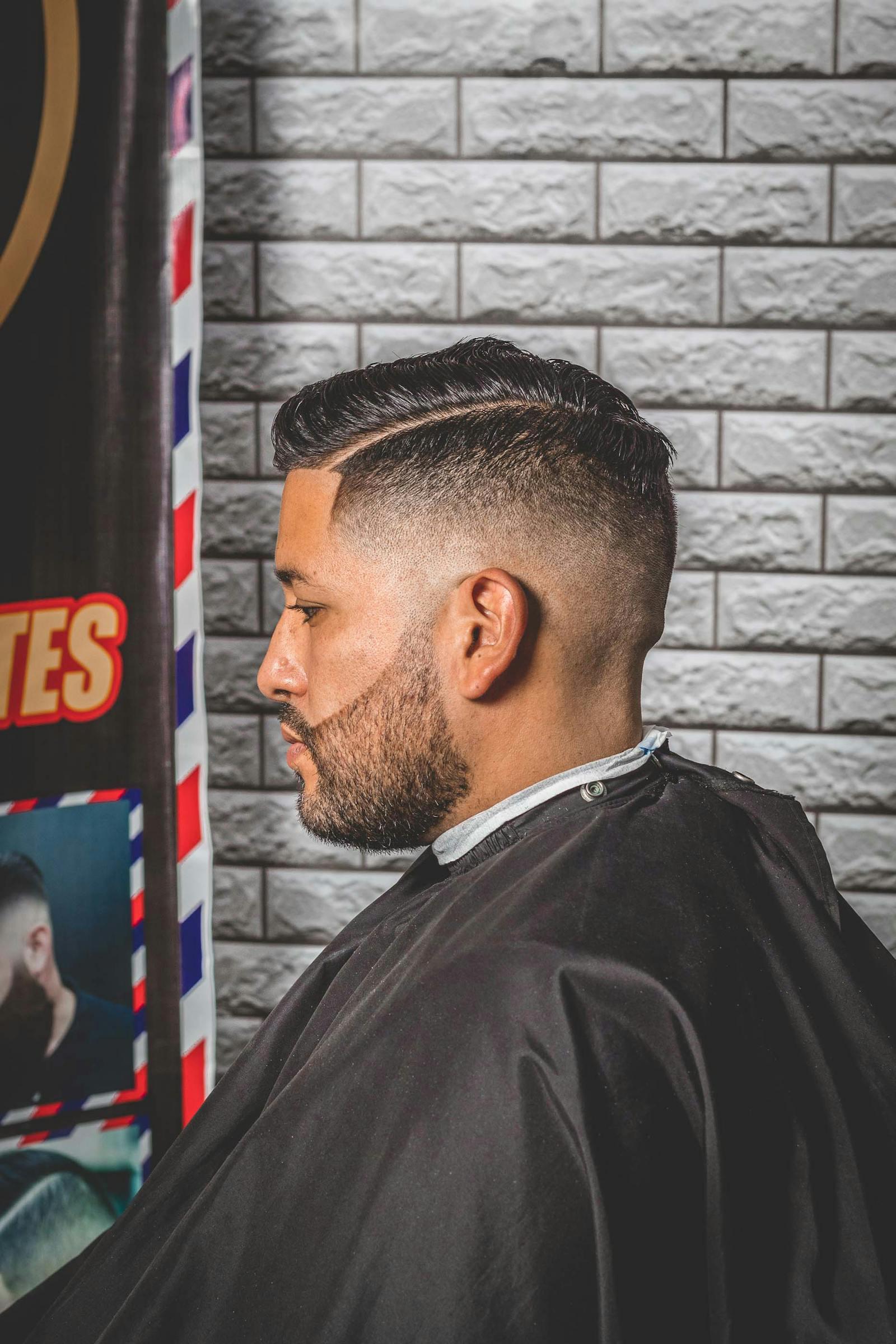
A mid fade puts the shortest part of the gradient at temple height and works the blend upward toward the longer hair on top. The transition sweeps around the back at that same height, so the entire upper-side and back are visibly shorter than what you have on top.
Three details define it:
- Start point — the fade begins at the temple, level with the top corner of your ear
- Shortest length — typically a half-guard (0.5), zero-guard (#0), or skin at the very bottom of the gradient near the neckline
- Top contrast — the longer hair on top sits above a visibly faded section, which makes any style on top read as deliberate
From the front, you can see the fade clearly — it's the focal point of the cut from any angle. From the side, the gradient runs in a clean diagonal from temple to neckline. From behind, the back of your head looks tighter and shorter than a taper or low fade would leave it.
Who asks for a mid fade in Sacramento:
- Tech workers and designers from Midtown and East Sac who want a current look without going full statement
- Tradespeople and contractors who want a clean, sharp look on the job
- Personal trainers and athletes who want their cut to register on camera
- Hospitality and bar industry workers downtown who want the cut to read sharp under low light
- Clients in their 20s and early 30s who want the cut to feel modern
- Anyone with thick hair who wants the cut to manage volume without looking conservative
The mid fade is the fastest-growing fade variant in Sacramento. Five years ago, low and high were the two ends of the conversation. In 2026, the mid is the centerpoint and increasingly the default for guys in their 20s and 30s.
What a High Fade Actually Looks Like
A high fade pushes the shortest part of the gradient much higher — up near the parietal ridge, the bony curve where the side of your skull meets the top. Everything below that ridge fades down to a short guard or to skin. The longer hair on top sits on what looks like a "plateau" running across the crown.
Three details define it:
- Start point — the fade begins at the parietal ridge, well above the temple and almost level with where your temples meet the crown
- Shortest length — almost always skin or a zero-guard at the bottom; half-guard high fades exist but are rare
- Top isolation — the longer hair on top is visually disconnected from the rest of the head, creating a "hat" of hair sitting above clean skin
From the front, the high fade reads as bold and deliberate from across the room. The contrast is immediate. From the side, you see the dramatic line where the short section meets the longer top. From behind, the back of your head is almost entirely skin or near-skin, with the longer hair contained to a small zone on top.
Who asks for a high fade in Sacramento:
- Guys with thick top hair who want the contrast to show off the styling on top
- Creative-industry professionals — designers, photographers, video producers — where statement haircuts are part of the work
- Personal trainers and fitness models who want their cut to read on camera
- Tradespeople in heat-heavy industries (roofing, construction, landscaping) who want the cooler feel
- Athletes — especially in summer
- Clients who want the cut to be the visible part of their style
A high fade is the riskier ask for office work. It's fine in most Sacramento creative or tech settings, but in finance, law, healthcare, or government client-facing roles it can read as too aggressive. If you work in a conservative industry and want some of the high-fade energy, ask for a mid fade with skin at the bottom — you get most of the visual punch without the workplace tension.
Pro Tip: If you can't decide between mid and high, ask for a "mid-high" fade — start the gradient halfway between the temple and the parietal ridge. It reads as bolder than a standard mid but more wearable than a true high. It's also one of the easier cuts to maintain mid-cycle with a quick neckline cleanup at week two.
Maintenance: How Often You'll Actually Need a Cut
Hair grows roughly half an inch per month according to the American Academy of Dermatology. That growth rate has a much bigger impact on a high fade than a mid one because the high fade's gradient sits in a more exposed part of your head with less hair above it to soften the grow-out.
| Cut | Looks Sharp For | Looks Acceptable Until | When to Rebook |
|---|---|---|---|
| Mid fade (half-guard at bottom) | 2-3 weeks | 4 weeks | Every 3 weeks |
| Mid fade (skin at bottom) | 10-14 days | 3 weeks | Every 2-3 weeks |
| High fade (zero-guard) | 10-14 days | 3 weeks | Every 2 weeks |
| High fade (skin at bottom) | 7-10 days | 2 weeks | Every 10-14 days |
The math compounds across a year. A mid fade rebooked every three weeks is about 17 cuts annually. A high fade rebooked every 10-14 days is 26-30 cuts. At Sacramento prices, that's a difference of $400-$700 a year — not a small number when you're choosing a haircut that's supposed to "save time."
For the full pricing breakdown by neighborhood, cut type, and tip convention, see our Sacramento men's haircut cost guide.
Which One Grows Out Better?
A mid fade grows out significantly better than a high fade, and the gap isn't close.
The reason is geometry. With a mid fade, the gradient lives at the temple, which means by week three the longer hair from the top has started to drape downward and soften the contrast. The cut still reads as intentional through week four. By week five it's a slightly shaggy modern haircut — not the look you wanted, but acceptable for most situations.
A high fade has nothing covering the gradient. The shortest section is exposed, and any grow-out shows immediately. By week two the contrast has lost its sharpness. By week three the cut looks like you forgot to rebook. By week four the high fade has effectively become a long mid fade, except your barber didn't actually design it that way.
If you travel for work, take 10-14 day trips, or just don't want haircuts running your calendar, a mid fade is the call. If your week is predictable and you can sit in the chair every two weeks like clockwork, a high fade rewards the commitment with a much sharper look at peak.
Mid Fade or High Fade for Sacramento Workplaces
For most Sacramento workplaces, the mid fade is the safer, more flexible choice — it reads as a modern, sharp haircut without crossing into statement territory. Here's how the variants land by industry, based on what we see walking through our doors:
- Finance, law, government, accounting, healthcare: mid fade only. A high fade is too style-forward in client-facing conservative roles and will draw comments.
- Standard corporate, tech, consulting, real estate: either variant works. The mid fade is the default. A high fade with a half-guard (instead of skin) at the bottom reads as fine in most Sacramento tech and startup environments.
- Creative, design, marketing, media, photography: either, with high fades becoming more common. The cut is part of the brand.
- Trades, construction, fitness, hospitality back-of-house: either, with high being slightly more popular in summer for the cooler feel.
- Service industry (bartending, food, retail management): mid fade is the safer call. High fades work but draw more management attention in chain or corporate-owned venues.
If you work in a conservative office Monday through Friday but want a sharper personal look on weekends and after work, commit to the mid variant. The cut still reads sharp without forcing a workplace conversation.
Face Shape: Which Variant Flatters Your Face
Both variants work for most face shapes, but each one plays differently with facial geometry.
Round face: mid fade is the better default — it adds some vertical structure without overdoing it. A high fade on a round face can work but it shortens the visible top section, which can compound the roundness. If you have a round face and want a high fade, keep the top long.
Square face: either variant works beautifully. A mid fade softens the angles slightly. A high fade emphasizes the jawline and looks dramatic. Pick based on the look you want.
Oval face: the most flexible shape. Both variants flatter equally. Default to mid for daily wear, high if you want the cut to be a visible part of your look.
Oblong or long face: mid fade is the smarter choice. A high fade can stretch the face visually because it adds vertical line above the temple.
Diamond face (wider at the cheekbones, narrower at the forehead and jaw): high fade looks excellent — the dramatic contrast frames the cheekbones and balances the face shape. This is one of the few face shapes where high fade is the clear winner over mid.
Heart-shaped face (wider forehead, narrow chin): mid fade is the better call. A high fade emphasizes a wide forehead because more skin is visible.
For more on matching cuts to your face, our beard style by face shape guide covers facial geometry in more depth and pairs naturally with this fade decision when you're building a complete look.
How Often Should You Refresh a High Fade?
Plan on refreshing a high fade every 10-14 days to keep the contrast crisp. The fade itself dulls faster than any other variant because the shortest section is the most exposed — there's no longer hair above the gradient to disguise the grow-out, so any half-inch of growth shows immediately.
Specific guidance by hair type:
- Thick, coarse hair: every 10 days; growth is fastest visible
- Medium thickness: every 12-14 days
- Fine or thin: every 2 weeks; less density buys you a few extra days
- Curly or coily: every 10-14 days; curl pattern emphasizes contrast loss
- Gray or salt-and-pepper: every 10-14 days; gray hair shows contrast loss faster than dark hair
If two-week rebooks aren't realistic for your schedule or budget, downgrade to a mid fade. The maintenance gap between the two is real, and a stretched high fade looks worse at week 4 than a stretched mid fade does at week 5.
Pricing in Sacramento: What You'll Actually Pay
Prices at Tay's Barbershop and most quality Sacramento shops in 2026:
- Mid fade with half-guard blend: $40-$50
- Mid fade with skin at bottom: $45-$55
- High fade with zero-guard: $45-$55
- High fade with skin at bottom: $50-$60
- Add-ons (hard part, line designs, hot towel finish): +$5-$20
Tipping convention in Sacramento runs 20%, with $5 the minimum for any cut under $40. Our full men's haircut cost guide for Sacramento breaks down annual cost by cut frequency, neighborhood, and tip practice — useful math if you're choosing between a mid and a high based on budget.
How to Ask for Either Cut Without Confusion
Verbal descriptions of fades fall apart constantly. Use this exact script:
- Name the cut: "I want a mid fade" or "I want a high fade."
- Name the start point: "Start the fade at the temple" (mid) or "Start the fade at the parietal ridge, well above the temple" (high).
- Name the shortest length: "Half-guard at the bottom" (mid, conservative), "Zero-guard at the bottom" (high or mid, sharp), or "Skin at the neckline and bottom" (any variant, maximum contrast).
- Name what you want on top: "Leave about 2 inches, textured, flowing forward" or whatever style you want.
- Bring a reference photo. Always. Two photos — one from the side, one from the back — eliminate 90% of the ambiguity.
If you want help dialing in a top style to pair with either fade, our guide to professional fade techniques every Sacramento man should know walks through the top-and-fade combinations our barbers cut most often.
Mini-Story: Two Sacramento Clients, Same Hair, Different Variants
We see this scenario every weekend at our Tahoe Park shop. Two guys, both early 30s, both with thick dark hair, both wanting "a fade."
Client A is a senior software engineer at a downtown Sacramento fintech. He has client-facing meetings on Tuesdays and Thursdays, but otherwise works remote. He wants the cut to read sharp on camera for Zoom and clean enough for the in-office days. We give him a mid fade with a zero-guard at the bottom, sideburns kept clean, two inches textured on top swept back. The cut reads sharp on camera and professional in person. He rebooks every three weeks.
Client B is a personal trainer at an East Sac gym who films short-form video for his client pipeline and competes in physique competitions. He wants the haircut to register on every camera angle. We give him a high fade with skin at the bottom, hard transition line, three inches textured on top with a slight pomp. The contrast pops in his videos. He rebooks every 12 days.
Same hair. Same chair. $10 price difference per cut. But across a year, Client A pays roughly $750 for his cuts and Client B pays roughly $1,650 — for fundamentally the same haircut philosophy, just at different fade heights. The variant decision is the entire game.
How to Pick Between Them: A 5-Question Checklist
Answer these honestly before walking in:
- How often will you realistically rebook?
- Every 10-14 days: high fade works
- Every 2-3 weeks: mid fade
- Every 3+ weeks: mid fade (or downgrade to a low or mid taper)
- What does your workplace look like?
- Conservative client-facing: mid only
- Standard corporate or tech: either, mid is default
- Creative, trades, fitness: either, lean high for sharper look
- What is your face shape?
- Round, heart, oblong: mid is the smarter choice
- Oval, square: either flatters
- Diamond: high fade is the clear winner
- What does your hair on top do?
- Short to medium top (1-2 inches): mid fade
- Medium to long top (2-4 inches): either, with high amplifying the styling on top
- Very long top (4+ inches, pompadour/quiff territory): high fade pairs naturally
- Do you want the haircut to be visible from across the room?
- Yes — personal brand, social media, photos matter: high
- Sharp but not loud: mid
- You want the cut to be quiet polish: drop down to a low or mid taper fade
If your answers cluster around frequent, creative, and visible, take the high fade. If they cluster around bi-weekly to monthly, professional, and balanced, take the mid. If they're split, default to mid — it's the more forgiving cut at every grow-out stage.
Common Mistakes Sacramento Clients Make
A handful of patterns we see constantly:
- Asking for "a fade" without a variant. This forces the barber to guess based on what's currently trending, which may or may not match what you actually want. Always specify mid, high, low, or taper.
- Asking for a high fade and then complaining it shows. The whole point of a high fade is visibility. If the contrast bothers you within a week, you wanted a mid.
- Choosing high without committing to the rebook schedule. A high fade rebooked every four weeks isn't a high fade — it's a long mid fade that looks worse than the actual mid would have.
- Going skin at the bottom when you've never had a fade before. Start with a half-guard or zero-guard. Skin contrast can read as too aggressive on first-timers and there's no way to undo it for a week.
- Skipping the reference photo. Two photos — side and back — solve almost every ambiguity. Even regulars at our shops bring photos for new variants.
- Picking the variant based on a celebrity's photo. Celebrities get cuts the day of a shoot. The look you're seeing is day-one, perfectly styled, lit, and retouched. Plan for what your version of that cut will look like at day 10 and day 20.
Mid Fade vs High Fade FAQ
What is the difference between a mid fade and a high fade?
A mid fade starts the gradient at the temple — level with the top of your ear — and works upward, leaving a balanced visual transition. A high fade starts the gradient at the parietal ridge, well above the temple, creating dramatic contrast between the longer hair on top and the very short skin or zero-guard below. The mid variant is the modern default in Sacramento and rebooks every 2-3 weeks. The high variant is the statement cut and rebooks every 10-14 days.
Is a mid fade or high fade better for the office?
A mid fade is better for most Sacramento offices, especially conservative ones like finance, law, government, healthcare, and corporate roles. It reads as a modern, sharp haircut without crossing into statement territory. A high fade is fine for creative, tech, trades, fitness, and hospitality roles in Sacramento, but can feel too aggressive in conservative client-facing jobs. When in doubt, mid.
How often do you need to refresh a high fade?
A high fade needs a refresh every 10-14 days to keep the contrast crisp. Hair grows roughly half an inch per month, which dulls the gradient between the longer top and the short faded section very quickly because nothing covers the shortest part of the cut. Thick, coarse, or gray hair shows the grow-out fastest. By week three, a high fade has effectively become a stretched mid fade.
Does a mid fade grow out better than a high fade?
Yes. A mid fade grows out significantly better than a high fade. The mid variant's gradient sits at the temple, where the longer hair above it drapes down and softens the grow-out. By week 4-5 a mid fade still reads as intentional. A high fade has nothing covering the gradient, so the contrast loss is visible by day 10 and the cut looks shaggy by week 3.
What is the most popular fade variant in Sacramento right now?
The mid fade with a zero-guard or half-guard blend is the fastest-growing variant across all three Tay's Barbershop locations and the single most-requested fade for guys in their 20s and 30s. It reads as current, works in almost every workplace, and rebooks at a manageable three weeks. The low taper fade still leads in raw volume, but the mid fade is the trend line.
Can I switch from a high fade to a mid fade without growing out?
Yes, easily. Any barber can convert a fresh high fade into a mid fade in a single visit by lengthening the lower portion of the gradient and softening the transition. You'll lose the dramatic contrast from the front but the cut will still look intentional. Going the other direction (mid to high) is also a single-visit change. If you're not sure which variant suits you, try a mid first — you can always go higher next time.
Does a high fade work for curly hair?
Yes — a high fade is one of the better fade choices for curly or coily hair because the dramatic contrast emphasizes the texture of the longer top section. The cut frames curls instead of fighting them. The key is keeping enough length on top (at least two inches) for the curl pattern to show. A high fade with a buzzed top defeats the point.
How do I ask my barber for a mid fade or high fade?
Tell the barber: "I want a [mid / high] fade, [half-guard / zero-guard / skin] at the bottom, with [length and style] on top." Then show a side-view reference photo and a back-view reference photo. At Tay's Barbershop, we walk every first-time fade client through the variant decision on a face chart before the clippers turn on — no charge, no pressure, and it eliminates the most common source of disappointment.
What is a mid-high fade?
A mid-high fade is a variant that starts the gradient halfway between the temple and the parietal ridge — higher than a true mid but lower than a true high. It reads bolder than a standard mid fade but more wearable than a full high fade, and it sits in a slightly more forgiving grow-out zone. It's a good middle option when you can't commit to a 10-14 day high-fade rebook schedule but want more visible contrast than a standard mid.
Book Your Mid or High Fade at Tay's Barbershop
Every barber at Tay's Barbershop in Sacramento cuts mid and high fades every single day. We can walk you through the variant decision in 60 seconds before the cut starts — no pressure, no upsell, no commitment.
- Sacramento flagship in Tahoe Park — open daily, walk-ins welcome, central location off Broadway
- Rancho Cordova — full service with appointments and walk-ins, easy parking off Folsom Blvd
- Howe Ave (Arden-Arcade) — open daily until 9 PM for after-work fades
Looking for a more conservative ask? See our low taper fade vs mid taper fade guide or the skin fade haircut walkthrough. New to Sacramento and shopping shops? Start with the best barbershop in Sacramento for a fade guide.
Bring two reference photos, tell us your rebook tolerance and your workplace, and we'll dial in the exact fade variant — mid, high, or somewhere in between — that fits your face, your job, and your calendar.
We'll see you in the chair.
Ready for a Fresh Look?
Book your appointment at Tay's Barbershop today. Walk-ins welcome at all three locations.