TL;DR: A low taper fade starts the gradient just above the ear and along the neckline, keeping the sides of your head visually full and the cut conservative. A mid taper fade starts the gradient at the temple, level with the top of the ear, exposing more skin and creating a sharper, more modern silhouette. Pick low if you work in a traditional office, want 3-4 weeks between visits, or prefer a subtle look. Pick mid if you want a cleaner, sharper cut for photos, work in a casual or creative environment, and don't mind rebooking every 2-3 weeks. The Sacramento default at Tay's Barbershop is the low taper fade with a one-guard blend -- it works for almost every face, every workplace, and every hair type.
Low Taper Fade vs Mid Taper Fade: The Quick Answer
The difference between a low taper fade and a mid taper fade is where the fade starts on your head.
- Low taper fade: the blend begins just above the ear and wraps around the neckline. From the front, you can barely tell anything is faded -- the cut reads as a sharp, traditional haircut.
- Mid taper fade: the blend begins at your temple, roughly even with the top of the ear, and runs around the back. From the front, the contrast is visible. The cut reads as deliberately modern.
That single decision -- where the gradient starts -- changes the maintenance schedule, how the cut grows out, what face shapes it flatters, and how it lands in different Sacramento workplaces. We cut hundreds of these every week across our Tahoe Park, Rancho Cordova, and Howe Ave shops, and the variant choice is the most common thing first-time clients get wrong.
If you're still figuring out the bigger taper-versus-fade question, start with our taper vs fade explainer and then come back here to dial in the variant.
Side-by-Side Comparison
Here is how the two variants stack up on the things that actually matter when you're sitting in the chair:
| Feature | Low Taper Fade | Mid Taper Fade |
|---|---|---|
| Where the fade starts | Just above the ear, along the neckline | At the temple, level with the top of the ear |
| Visible contrast from the front | Very subtle | Clearly visible |
| Best for workplaces | Every workplace, including conservative ones | Most workplaces; pushback rare in Sacramento |
| Maintenance window | 3-4 weeks | 2-3 weeks |
| Typical Sacramento price | $35-$50 | $35-$55 |
| Hair needed on top | Any length | Any length, but more length amplifies contrast |
| Best face shapes | Round, square, heart -- almost any | Oval, oblong, square; can shorten round faces visually |
| Grow-out behavior | Blends gracefully, looks acceptable for 5-6 weeks | Loses sharpness faster, looks shaggy by week 4 |
| Photo presence | Quiet, professional | Sharp, deliberate |
The price spread between the two is small at most Sacramento shops -- usually $0-$5. The real cost difference shows up in how often you sit in the chair across a year.
What a Low Taper Fade Actually Looks Like
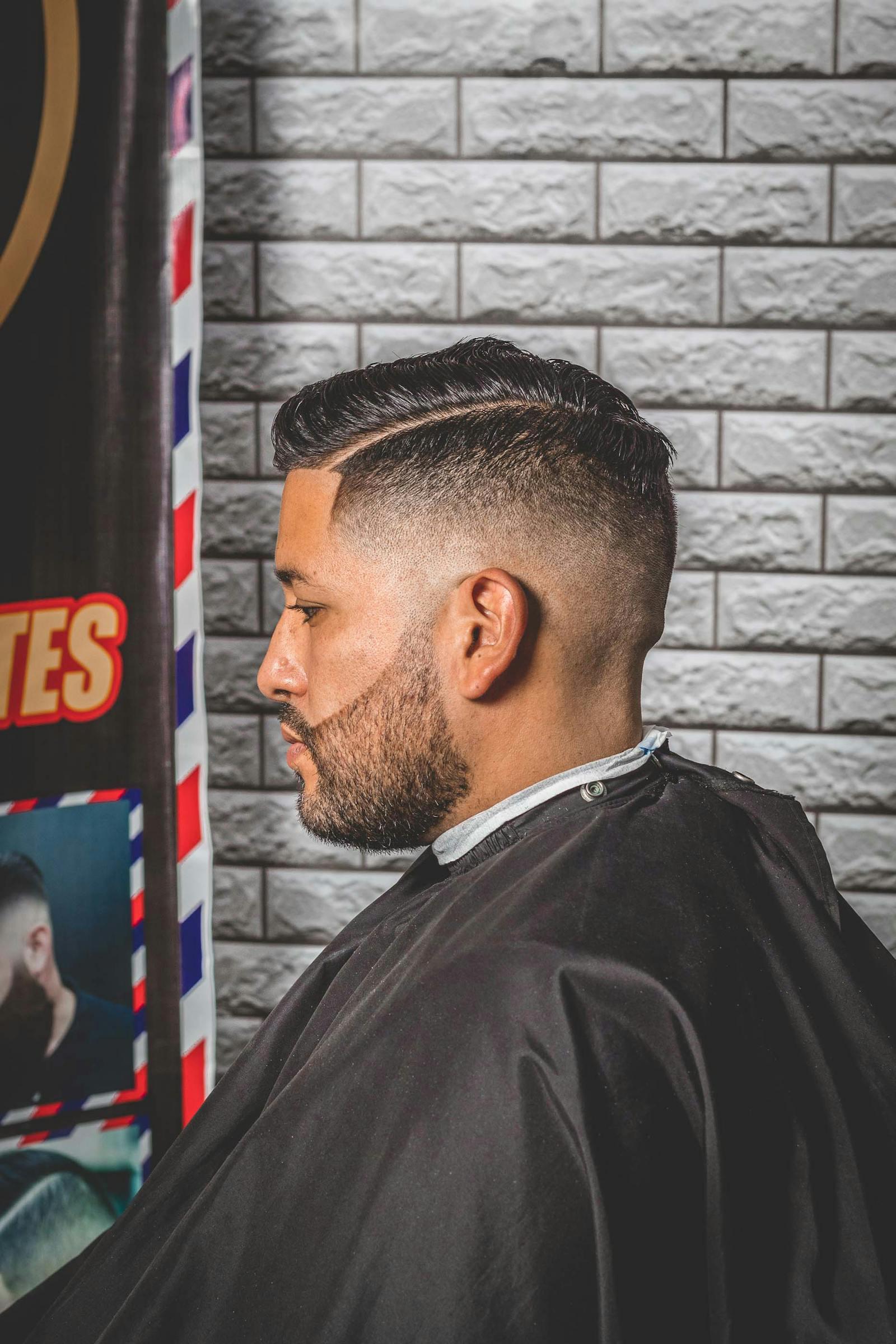
A low taper fade keeps the entire side of your head visually full. The gradient lives in a narrow band above the ear and around the neckline, blending from longer hair down to a short guard length or near-skin at the very bottom.
Three details define it:
- Start point -- the fade begins about half an inch above the top of your ear, never higher
- Shortest length -- usually a half-guard (0.5) or one-guard (1) at the bottom; a true skin-low-taper-fade goes to bare skin only at the neckline
- Sideburn treatment -- sideburns are kept and softened into the fade rather than erased
From the front, a low taper fade looks almost identical to a standard scissor cut. From the side, you see the subtle gradient kick in just above the ear. From behind, the neckline is clean and gradiented instead of squared off.
Who asks for a low taper fade in Sacramento:
- Lawyers, accountants, financial advisors, and government workers downtown
- Real estate agents, mortgage brokers, and consultants in Midtown
- Hospitality and food service managers who need to look polished, not edgy
- Dads who want to stretch to 4 weeks between visits
- Anyone with thin or fine hair where high contrast looks harsh
- First-time barbershop clients nervous about going too short
The low taper fade is the single most-requested cut at our Tay's Barbershop locations, especially among working professionals who commute into downtown Sacramento. If you don't know what to ask for, this is the safe answer.
What a Mid Taper Fade Actually Looks Like
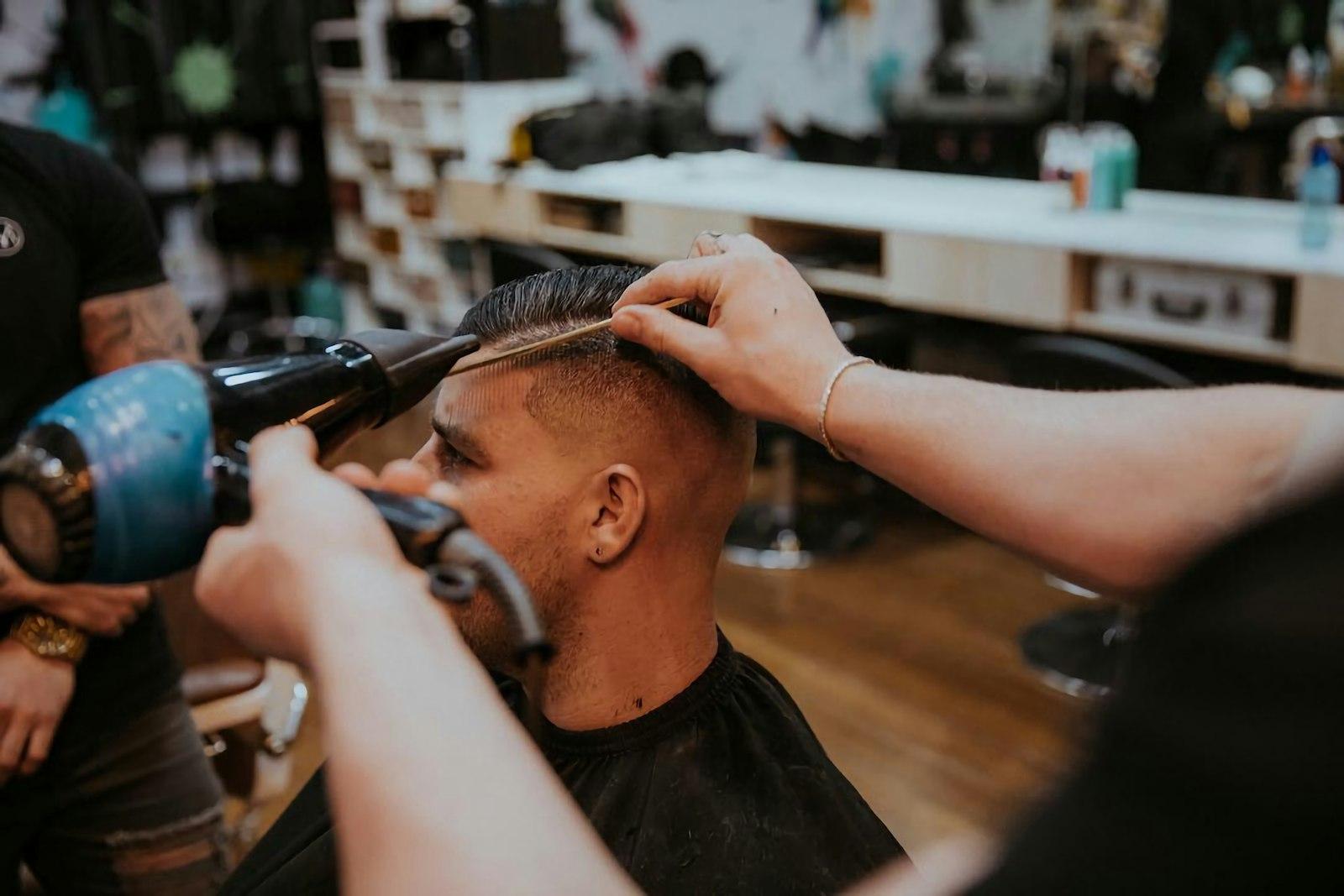
A mid taper fade moves the gradient up. Instead of starting above the ear, the blend begins at your temple -- roughly the spot where your sideburn meets your hairline. The fade then sweeps around the back at that same height, taking down the upper sides and back to a short guard.
Three details define it:
- Start point -- the fade begins at the temple, level with the top corner of your ear
- Shortest length -- typically a half-guard (0.5) at the bottom; some clients ask for skin at the neckline only
- Top contrast -- the longer hair on top now sits above a visibly faded section, which makes any style on top look more deliberate
From the front, the cut reads as modern and intentional. You can see the fade. From the side, the gradient is the focal point of the haircut. From behind, the back of your head looks shorter and tighter than a low variant.
Who asks for a mid taper fade in Sacramento:
- Tech workers, designers, marketers, and creative professionals
- Tradespeople who want a clean, sharp look on the job
- Personal trainers, athletes, and coaches who care about photos
- Guys with curly or coily hair who want defined contrast against their texture
- Anyone with a round face who wants the cut to add vertical structure
- Clients in their 20s and early 30s where the style reads as current
The mid taper fade is a heavier ask in conservative industries. It is fine for most Sacramento offices, but if you work somewhere with a strict dress code, the low variant is a safer call.
Pro Tip: If you want the silhouette of a mid taper fade but the workplace tolerance of a low one, ask for a "low-mid" taper fade -- start the gradient about a finger's width above the ear, between a low and a true mid. It splits the difference and reads as clean from the front while still giving you visible contrast from the side.
Maintenance: How Often You Will Actually Need a Cut
Hair grows about half an inch per month, per the American Academy of Dermatology. That growth rate matters more for a mid taper fade than for a low one because the fade lives in a more visible part of your head.
| Cut | Looks Sharp For | Looks Acceptable Until | When to Rebook |
|---|---|---|---|
| Low taper fade (one-guard) | 3 weeks | 5-6 weeks | Every 4 weeks |
| Low taper fade (skin at neckline) | 2-3 weeks | 4-5 weeks | Every 3 weeks |
| Mid taper fade (half-guard) | 2-3 weeks | 4 weeks | Every 3 weeks |
| Mid taper fade (skin at neckline) | 10-14 days | 3 weeks | Every 2-3 weeks |
The math across a year is meaningful. A low taper fade rebooked every 4 weeks runs roughly 13 cuts a year. A mid taper fade rebooked every 3 weeks runs roughly 17 cuts. At Sacramento prices that's a difference of $140-$200 a year, which is the kind of thing worth knowing before you decide.
For the full pricing breakdown by neighborhood and cut type, see our Sacramento men's haircut cost guide.
Which One Grows Out Better?
A low taper fade grows out better than a mid taper fade, and it is not close.
The reason is geometry. The low variant's fade lives in an area of your head that gets covered by the longer hair sitting above it as the cut grows. After 3-4 weeks, the gradient softens, the longer hair drapes over the slightly faded zone, and the cut still reads as intentional. By week 5 it looks like a slightly shaggy traditional haircut -- still acceptable for most settings.
A mid taper fade has nothing covering it. The gradient sits at your temple, where it is visible from every angle. As soon as the contrast dulls, you can see it. By week 3 the sharpness is gone. By week 4 the cut looks like you forgot to book your appointment.
If you travel for work, take long trips, or just don't want haircuts running your calendar, the low variant is the better call by a wide margin.
Is a Low Taper or Mid Taper Better for Work?
For most Sacramento workplaces, the low taper fade is the safer, more flexible choice for work -- it reads as a polished traditional haircut from the front, which is what most managers and clients are responding to.
Here is how it shakes out by industry, based on what we see walk into our shops:
- Finance, law, government, accounting: low taper fade only. A mid variant is fine on paper but reads as too style-forward in client-facing roles.
- Hospitality, healthcare, education: low taper fade is the default. Mid is acceptable but draws comments.
- Standard corporate, tech, real estate, consulting: either variant is fine. Mid taper fade is increasingly common and reads as current.
- Creative, design, marketing, media: mid taper fade is the better call. Low can read as overly conservative for the industry.
- Trades, fitness, hospitality back-of-house: either, with mid being more popular. Style is celebrated.
If you work in a conservative office but want a sharper personal look on weekends, you can split the difference with the "low-mid" taper fade described above, or commit to the low variant and let your top hair do the styling work.
Face Shape: Which Variant Flatters You
Both variants work for most face shapes, but each one has natural strengths.
Round face: mid taper fade adds vertical structure and visually narrows the face. The low variant does the opposite -- it can amplify the roundness because the sides stay full. If your face is round and you want a leaner look, mid wins.
Square face: either works well. Low taper fade softens an aggressive jawline. Mid taper fade emphasizes structure. Pick based on the look you want.
Oval face: the most flexible shape. Either variant flatters. Default to low for conservative settings, mid for sharper looks.
Oblong or long face: low taper fade is the better choice. A mid variant can stretch the face visually because it adds more vertical line.
Heart-shaped face: low taper fade works best. Keeping more hair on the sides balances a wider forehead and pointed chin.
For more on matching cuts to your face, our beard style by face shape guide covers facial geometry in more depth and pairs naturally with this fade decision.
How Often Do You Need to Refresh a Mid Taper Fade?
Plan on a mid taper fade refresh every 2-3 weeks to keep the contrast sharp. The fade itself dulls fastest -- the gradient between the longer hair and the short section blurs as both grow out at the same rate, and the visual contrast is gone within 14-21 days for most hair types.
Specific guidance by hair type:
- Thick, coarse hair: every 2-3 weeks; growth is fast and visible
- Medium thickness: every 3 weeks
- Fine or thin: every 3-4 weeks; less density makes growth less visible
- Curly or coily: every 2-3 weeks; curl pattern emphasizes contrast loss
If 3 weeks is too aggressive for your schedule or budget, downgrade to a low taper fade. The maintenance gap is real.
Pricing in Sacramento: What You Will Actually Pay
Prices at Tay's Barbershop and most quality Sacramento shops in 2026:
- Low taper fade with one-guard blend: $35-$45
- Low taper fade with skin neckline: $40-$50
- Mid taper fade with half-guard blend: $40-$50
- Mid taper fade with skin contrast: $45-$55
- Add-ons (hard part, designs, hot towel finish): +$5-$20
Tipping convention in Sacramento runs 20%, with $5 the minimum for any cut under $40. Our full men's haircut cost guide for Sacramento breaks down annual cost by cut frequency and neighborhood.
How to Ask for Either Cut Without Confusion
Verbal descriptions of fades fail constantly. Use this exact script:
- Name the cut: "I want a low taper fade" or "I want a mid taper fade."
- Name the start point: "Start the fade just above the ear" (low) or "Start the fade at the temple" (mid).
- Name the shortest length: "One-guard at the bottom" (low) or "Half-guard at the bottom" (mid).
- Name what you want on top: "Leave about 2 inches, textured, flowing back" (or whatever style you want).
- Bring a reference photo. Always. Verbal descriptions are lossy. A photo from the side and the back removes 90% of the ambiguity.
If you want help dialing in a specific style on top to pair with either fade, our guide to professional fade techniques every Sacramento man should know walks through the top combinations our barbers run.
Mini-Story: Two Sacramento Clients, Same Hair, Different Variants
We see this scenario every Saturday at our Tahoe Park shop. Two guys, both early 30s, both with thick brown hair, both medium length on top.
Client A is a deputy district attorney. He walks in saying he wants "something cleaner" but doesn't want to look like he's chasing a trend. We give him a low taper fade with a one-guard blend, sideburns kept, scissor work on top to soften it. From the front in court the next morning, the cut reads as a sharp traditional haircut. Nobody comments. He rebooks 4 weeks out.
Client B is a personal trainer at a gym in East Sacramento who films short-form video for his client pipeline. He wants the haircut to register on camera. We give him a mid taper fade with a half-guard blend, harder transition line, textured crop on top. The contrast pops in his videos. He rebooks 2-3 weeks out.
Same hair. Same chair. $5 price difference. Completely different outcomes for completely different lives. The variant choice is the whole game.
How to Pick Between Them: A 5-Question Checklist
Answer these honestly before you walk in:
- How often will you realistically rebook?
- Every 2-3 weeks: either works
- Every 3-4 weeks: low taper fade
- Every 4+ weeks: low taper fade (or downgrade to a classic taper)
- What does your workplace look like?
- Conservative client-facing: low only
- Standard corporate: either
- Creative or trades: either, lean mid for sharper look
- What is your face shape?
- Round or heart-shaped: mid for structure or low for softness -- your call
- Oval, square, oblong: either flatters
- How does your hair texture handle contrast?
- Thick, coarse, dense: either works beautifully
- Curly or coily: mid emphasizes texture; low keeps it subtle
- Fine or thin: low hides density better than mid
- Do you want the cut to be visible in photos?
- Yes, for personal brand or social: mid
- No, you want quiet polish: low
If your answers cluster around conservative, infrequent, and quiet, take the low variant. If they cluster around modern, frequent, and visible, take the mid. If they're split, default to low -- it's the more forgiving cut.
Common Mistakes Sacramento Clients Make
A few things we see all the time:
- Asking for "a fade" without a variant. This forces the barber to guess. Always specify low, mid, or high.
- Asking for a mid taper fade and then complaining it shows. The whole point of a mid is visibility. If you don't want the contrast, you wanted a low.
- Asking for the cut shorter than you actually want. Half-guard and one-guard look very different. If unsure, go one length longer; you can always cut more next time.
- Skipping the reference photo. Even regulars at our shops bring photos for new variants. It saves the consultation and removes ambiguity.
- Booking too far apart for a mid. A mid taper fade rebooked every 5 weeks is just a shaggy haircut by week 4. If you can't commit to 3 weeks, take the low.
Low Taper Fade vs Mid Taper Fade FAQ
What is the difference between a low taper and mid taper fade?
A low taper fade starts the blend just above the ear and along the neckline, keeping the sides of your head visually full and the cut subtle from the front. A mid taper fade starts the blend at the temple, level with the top of your ear, exposing more skin and creating a sharper, more visible contrast. The low variant is more conservative and lasts longer between cuts; the mid variant is sharper and reads as more modern but needs a refresh every 2-3 weeks.
Is a low taper or mid taper better for work?
A low taper fade is better for most work environments, especially conservative ones like finance, law, government, hospitality, and healthcare. It reads as a polished traditional haircut from the front. A mid taper fade is fine for standard corporate, tech, creative, and trades roles in Sacramento, but can feel too style-forward in client-facing conservative jobs. When in doubt, low.
How often do you need to refresh a mid taper fade?
A mid taper fade needs a refresh every 2-3 weeks to keep the contrast sharp. Hair grows about half an inch per month, which dulls the gradient between the longer top and the faded section quickly. Thick or curly hair shows the grow-out fastest. By week 4, a mid taper fade looks shaggy from the side and back.
Does a low taper grow out better than a mid taper?
Yes. A low taper fade grows out significantly better than a mid taper fade. The low variant's gradient sits low enough on the head that the longer hair above it drapes over and softens the grow-out. By week 5-6 it still reads as a traditional haircut. A mid taper fade has nothing covering the gradient, so the contrast loss is visible immediately and the cut looks shaggy by week 4.
What is the most popular variant in Sacramento?
The low taper fade with a one-guard blend is the single most-requested cut across all three Tay's Barbershop locations. It works in every workplace, flatters every face shape, stretches to 4 weeks between visits, and pairs with any style on top. If you don't know what to ask for, this is the answer.
Can I switch from a mid taper fade to a low taper fade without growing out?
Yes, easily. Any barber can convert a fresh mid taper fade into a low taper fade in a single visit by lengthening the upper portion of the gradient. You will lose the visible contrast from the front but the cut will still look intentional. Going the other direction (low to mid) is also a single-visit change.
Does a low taper fade work for curly hair?
Yes -- a low taper fade is one of the better fade choices for curly or coily hair because it keeps more length on the sides, which preserves volume and avoids the patchy look that aggressive fades can create on certain curl patterns. If you want sharper definition, a mid taper fade or a drop fade pairs well with thick curls.
What should I tell my barber if I'm not sure which to pick?
Tell the barber: "I want a clean fade for work, and I'd like to come back every 3-4 weeks. What would you recommend?" That gives the barber the constraints to make the right call -- usually a low taper fade with a one-guard blend. At Tay's Barbershop, our barbers will walk you through the variants on a face chart before any clippers turn on.
Book Your Low or Mid Taper Fade at Tay's Barbershop
Every barber at Tay's Barbershop in Sacramento cuts low and mid taper fades every single day. We can walk you through the variant decision in 60 seconds before the cut starts -- no pressure, no upselling.
- Sacramento flagship in Tahoe Park -- open daily, walk-ins welcome
- Rancho Cordova -- full service with appointments and walk-ins
- Howe Ave (Arden-Arcade) -- open daily until 9 PM for after-work cuts
Bring a reference photo, tell us your weekly schedule, and we'll dial in the exact taper fade variant that fits your face, your job, and how often you actually want to come back.
We'll see you in the chair.
Ready for a Fresh Look?
Book your appointment at Tay's Barbershop today. Walk-ins welcome at all three locations.