TL;DR: A taper is a gradual shortening of the hair around the ears, sideburns, and neckline that keeps real length on the sides -- it never goes to skin. A fade goes shorter and exposes skin (or near-skin) somewhere on the sides or back, blending up from bare to longer hair on top. If you want conservative and low-maintenance, ask for a taper. If you want a sharper, more dramatic look and you're okay coming in every 2-3 weeks, ask for a fade. A taper fade is the in-between: a fade that stops shorter than a skin fade and blends gently into a tapered neckline.
Taper vs Fade: The Fast Answer
The single biggest difference is how much skin shows on the sides.
- A taper keeps hair on the sides and back. It just gets gradually shorter toward the ears, sideburns, and neckline. Your sideburns stay intact. Your natural hairline stays visible.
- A fade removes hair down to bare or near-bare skin somewhere on the sides or back, then blends back up into longer hair on top. There's a visible contrast between skin and hair.
At Tay's Barbershop in Sacramento, roughly 7 out of 10 first-time clients who ask for "a fade" actually describe a taper when we walk through the details -- and the other way around. Getting the vocabulary right before you sit in the chair saves you a haircut you didn't want.
For a deeper technical breakdown of fade variants specifically, see our guide to professional fade techniques every Sacramento man should know.
Side-by-Side: Taper vs Fade
Here's the cleanest way to think about it when you're standing at the mirror deciding:
| Feature | Taper | Fade |
|---|---|---|
| Shortest point | Guard 1 or 2 (hair still present) | Skin or near-skin (0.5 guard or bald) |
| Where it happens | Sideburns, around the ears, neckline | Full sides and back, blending up |
| Sideburns | Kept, just shortened gradually | Often faded away entirely |
| Contrast level | Subtle | High |
| Best for workplaces | Every workplace, zero questions | Most workplaces, some conservative industries may push back |
| Maintenance window | 3-4 weeks | 2-3 weeks (skin fade: 10-14 days) |
| Typical Sacramento price | $30-$45 | $35-$55 |
| Hair needed on top | Any length | Any length, but more length = more dramatic contrast |
If you want the numbers behind those price ranges, our full Sacramento men's haircut cost guide breaks down what every service actually costs in 2026.
What Is a Taper, Exactly?
A taper is a gradient -- hair length decreases smoothly as it approaches the ears, sideburns, and back of the neck, but it never hits bare skin.
A classic taper touches only three zones:
- The sideburns -- shortened so they fade into the skin instead of ending in a hard line
- Around the ears -- cleaned up so hair doesn't stick out or curl over
- The neckline -- blended into the neck gradually instead of sitting as a blunt rectangle
Everything above those zones stays at the length of the rest of your haircut. That means a taper pairs with almost any style on top: slick-back, side part, curly texture, pomp, even longer grown-out looks.
Who a taper is right for:
- Professional settings where you want to look put together without a dramatic cut
- Guys who want to stretch to 4+ weeks between visits
- Thin or fine hair, where too much skin exposure looks harsh
- First-time barbershop clients who are nervous about going too short
- Men growing out a longer style but still want clean edges
What Is a Fade, Exactly?
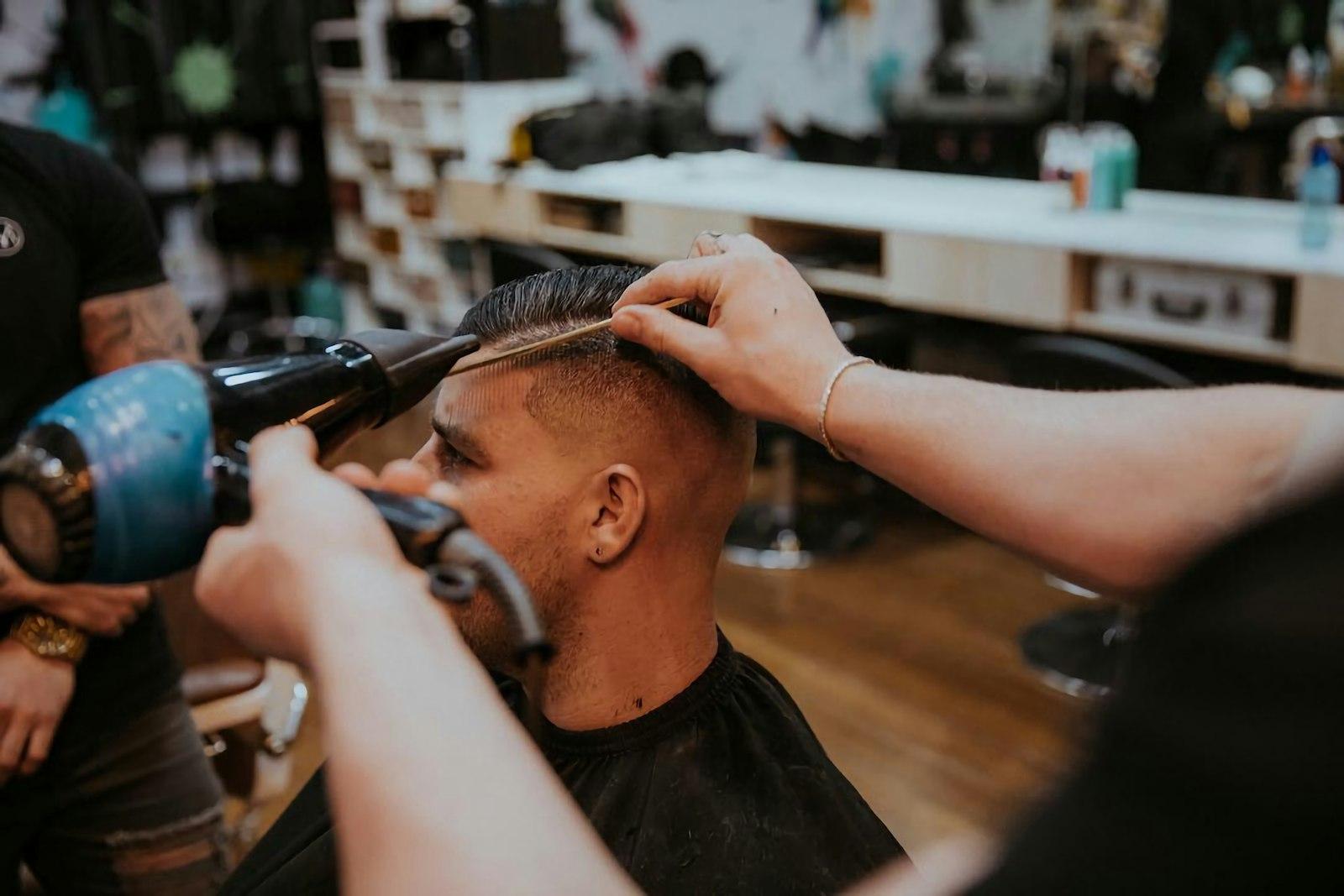
A fade also uses a gradient, but it runs the full side and back of the head, and the shortest point goes to skin or very close to it. The hair on top stays long, creating a high-contrast look where you can see the bare scalp underneath a disconnected top.
Three things define any fade:
- Where the fade starts -- low, mid, or high on the head
- How short the shortest point is -- skin, half-guard, or one-guard
- How gradual or sharp the blend is -- some fades blur across 4 inches, others compress into 1 inch for a crisper look
Who a fade is right for:
- Guys who want a sharp, modern, visibly styled look
- Clients with thick or coarse hair that can handle aggressive shortening without looking patchy
- Anyone okay coming in every 2-3 weeks
- Most face shapes -- variant choice (low, mid, high) adjusts it to your face
- Athletes and active guys who want less hair to manage in the summer
The Low, Mid, and High Variants
Both tapers and fades come in low, mid, and high versions. The variant just tells you where on your head the gradient starts.
Low Taper vs Low Fade
- Low taper: gradient sits just above the ears and along the neckline. Barely noticeable from the front. Most conservative option available at a barbershop.
- Low fade: gradient starts at the same spot as a low taper but goes to skin. From the front the cut looks almost identical to a traditional haircut; from the side and back you see the sharp transition to skin.
Which to ask for: Low taper if you work in finance, law, government, or hospitality. Low fade if you want a cleaner side profile but still want to keep things subtle. The low fade is the single most requested variant we see at our Rancho Cordova shop for professionals commuting into downtown Sacramento.
Mid Taper vs Mid Fade
- Mid taper: gradient starts at your temple, roughly level with the top of the ear. Keeps hair on the sides but makes the transition higher and more visible.
- Mid fade: same starting point, but goes to skin. This is the "default fade" people picture when they say "just give me a fade."
Which to ask for: Mid fade if you're unsure. It's the most flexible and works for almost every face shape and hair type. A mid taper is unusual -- most guys who want a mid-height gradient want the skin contrast that only a fade delivers.
High Taper vs High Fade
- High taper: gradient starts above the temple, near the top corner of the forehead. Rare, because at that height most people want full contrast -- a taper that high can look awkward.
- High fade: gradient starts high and takes almost the entire side and back to skin. Dramatic, bold, and shortens the visual length of the sides of your head. Good for guys with rounder faces who want more angular structure.
Which to ask for: High fade if you want the cut to be the outfit. Skip the high taper -- 9 times out of 10 the guys who ask for it actually want a mid fade.
What About a "Taper Fade"?
A taper fade is the bridge between the two -- a fade that stops shorter than a skin fade but more aggressive than a traditional taper. Usually this means the shortest point is a half-guard (0.5) or one-guard (1) rather than bare skin.
It's the most requested cut at Tay's Barbershop across all three of our Sacramento locations. Reasons:
- Sharper than a taper, softer than a skin fade
- Works in every workplace, including conservative ones
- Stretches to 3 weeks easily, sometimes longer
- Complements any face shape
- Pairs with any top style, from short crops to longer pomps
If a friend or an Instagram photo shows "a really clean fade that doesn't look extreme," it's almost always a taper fade. For a full breakdown of the specific variants our barbers run, see our guide to the best barbershop in Sacramento for a fade.
Pro Tip: If you don't know what you want but you want to look sharp for work, ask for a low taper fade with a one-guard blend. That specific combination fits every face, every workplace, and every hair type we see at our Tahoe Park and Howe Ave shops.
Which Lasts Longer: Taper or Fade?
A taper holds its shape meaningfully longer than a fade. Rough maintenance windows for Sacramento clients at our shops:
| Cut | Looks Sharp For | Looks Acceptable Until | When to Rebook |
|---|---|---|---|
| Classic taper | 3-4 weeks | 5-6 weeks | Every 4 weeks |
| Taper fade (one-guard) | 2-3 weeks | 4 weeks | Every 3 weeks |
| Mid or low skin fade | 10-14 days | 3 weeks | Every 2-3 weeks |
| High skin fade | 7-10 days | 2 weeks | Every 2 weeks |
The reason: hair grows about half an inch per month, per the American Academy of Dermatology. On a skin fade, that half-inch destroys the contrast almost immediately. On a taper, the gradient is already longer to begin with, so the growth blends into the existing shape for much longer before it starts to look shaggy.
If you want to stretch the window between cuts for budget reasons, a taper (or a conservative taper fade) is mathematically the better choice. Our Sacramento haircut cost guide has a full annual-cost breakdown by cut frequency.
How to Decide: A 4-Question Checklist
Before you walk into the shop, answer these four questions honestly:
- How often are you realistically willing to get a haircut?
- Every 2 weeks, no excuses: any fade is fine
- Every 3 weeks: taper fade or low fade
- Every 4+ weeks: taper
- What does your workplace look like?
- Conservative (finance, law, government, hospitality): taper or low taper fade
- Standard office: any low or mid variant
- Creative, tech, trades: any variant including high fade
- What's your hair texture?
- Thick, coarse, dense: fades blend beautifully -- any variant works
- Fine or thin: tapers hide thinning better than skin fades
- Curly or textured: drop fade or taper fade flatters the natural shape
- How much contrast do you actually want?
- Subtle, nobody-really-notices: taper
- Clean and modern: taper fade
- Sharp and deliberate: skin fade
If your answers are scattered across categories, lean taper fade -- it's the most forgiving cut for mixed priorities.
Mini-Story: Two Clients, Same Hair, Different Cuts
We see this weekly. Two guys walk in on the same Saturday, both with medium-thick brown hair, both early 30s.
Client A works as a mortgage broker in Midtown. He wants to "look clean" but doesn't want his boss's older clients to notice a new haircut. He gets a low taper with scissor work on top -- sideburns cleaned, neckline gradiented, hair on the sides kept at a 3-guard. Rebooks 4 weeks out.
Client B works as a personal trainer. He wants his haircut to do work in photos for his online brand. He gets a mid skin fade with a textured crop on top. The contrast pops in his selfies. He rebooks 2 weeks out.
Same hair, same price within $5, completely different results. The variant choice is the whole ballgame.
Do Barbers Charge Differently for Tapers vs Fades?
At most Sacramento shops, yes -- by about $5-$10. A fade takes more passes, more guard changes, and more blade work than a taper, so it costs slightly more.
- Standard taper: roughly $30-$45 in Sacramento
- Taper fade or low fade: roughly $35-$50
- Skin fade: roughly $35-$55
- Skin fade with hard part or design: +$5-$20 on top
Our Sacramento haircut cost guide has the full breakdown with neighborhood-by-neighborhood pricing, plus what to tip.
What to Actually Tell Your Barber
The cleanest way to communicate either cut:
- Name the cut: "I want a low taper fade."
- Name the shortest length: "One-guard at the bottom, please."
- Name the start point: "Start the fade just above the ear."
- Name what you want on top: "Leave about 2 inches, textured, flowing back."
- Bring a reference photo. This is the single highest-leverage thing you can do. Verbal descriptions are lossy. Photos aren't.
The National Association of Barbers of America ranks clear client-barber communication as the top predictor of haircut satisfaction across their nationwide member shops.
If you're brand new to a barbershop, our barbershop experience guide walks through every step of a first visit, and our how to choose the right barber in Sacramento post helps you pick the right shop before you show up.
Taper vs Fade FAQ
What is the difference between a taper and a fade?
A taper is a gradual shortening of hair around the sideburns, ears, and neckline that keeps real length on the sides -- it never goes to skin. A fade goes shorter and exposes skin or near-skin across the full sides and back, creating high contrast with the longer hair on top. A taper is subtle; a fade is sharp.
Is a taper the same as a fade?
No. A taper keeps hair on the sides (usually a 1-, 2-, or 3-guard) and just softens the edges. A fade takes the hair down to bare skin somewhere on the head. They look similar from the front, but from the side the difference is immediately visible.
Should I get a taper or a fade?
Get a taper if you want low maintenance, a conservative look, or your workplace is traditional. Get a fade if you want a sharp, modern, high-contrast cut and you're okay visiting the barber every 2-3 weeks. If you're torn, a taper fade is the best of both worlds.
Which lasts longer, a taper or a fade?
A taper lasts longer -- typically 3-4 weeks before it needs a rebook, compared to 2-3 weeks for a fade and just 10-14 days for a skin fade. Hair grows about half an inch per month, which destroys a skin fade's contrast fast but blends into an already-longer taper gracefully.
What is a taper fade haircut?
A taper fade is a hybrid cut where the sides and back blend from longer hair down to a short (usually half-guard or one-guard) length rather than all the way to skin. It's sharper than a traditional taper but softer than a skin fade -- and it's the most-requested cut across all three Tay's Barbershop Sacramento locations.
Low taper vs low fade -- which one should I pick?
Pick a low taper if you want the cleanest professional look with minimal contrast and maximum time between visits. Pick a low fade if you want a sharper side profile with visible skin exposure at the bottom but still understated from the front. Low fades are the most-requested fade variant we see on working professionals commuting into downtown Sacramento.
Does a taper work for curly hair?
Yes -- a taper can actually be the better choice for curly or textured hair than a mid or high fade, because it preserves volume on the sides and avoids the patchy look that skin fades can create on very curly hair. If you want contrast with curly hair, a drop fade or taper fade usually flatters the natural shape best.
Can I go from a fade to a taper without growing out?
Yes. Any barber can convert a fresh fade into a more tapered look by lengthening the shortest point, though you'll lose the high-contrast element immediately. Going the other direction (taper to fade) is easier and happens in a single visit.
Book Your Taper or Fade at Tay's Barbershop
Every barber at Tay's Barbershop specializes in both tapers and fades -- low, mid, high, taper fade, drop fade, skin fade, you name it. We cut hundreds of these every week across Sacramento.
- Sacramento flagship in Tahoe Park -- open daily, walk-ins welcome
- Rancho Cordova -- full service with appointments and walk-ins
- Howe Ave (Arden-Arcade) -- open daily until 9 PM for after-work cuts
Still not sure which variant to ask for? Walk in, tell the barber what your week looks like, and we'll dial in the exact taper, fade, or taper fade that fits your face, your workplace, and how often you actually want to come back.
We'll see you in the chair.
Ready for a Fresh Look?
Book your appointment at Tay's Barbershop today. Walk-ins welcome at all three locations.